
Each military vessel has its own story to tell. However, it is only natural to be more curious when you chance upon an abandoned submarine. You would not be able to believe the stories about these vehicles that we are about to tell you. The creation of these machines is practically a miracle in itself but wait until you hear what these things have gone through. Some of them have been found along the shores, while others were discovered in dark and eerie tunnels. They have been used during the Second World War and the Cold War for covert operations. If you appreciate your history, read on!
These Deserted Submarines And Bases Will Give You Goosebumps Like Nothing Else
Soviet Naval Base
Simushir Island is part of an island chain created by volcanic activity and lies around 250 miles away from the coast of Japan. If you take a glance at it, no one would ever think that this deserted island is full of rusted ruins that makes it look a lot like a villain’s lair. It was not always like this as the Soviet Union used its northern part as a secret base for their submarines after they blasted a channel through it and into Broutona Bay during the late ‘70s. They built a whole town around this base, which was the place of residence of 3,000 people at its peak. There were three docks for submarines, and one of these remains intact to this day. The vessels were used to plant explosives and mines in northern Japan. The base also functioned as a radar situation at some point. Nowadays, the only traces of the military location would be the murals, signs, maps, and submarines…
Soviet Naval Base
The Sub Marine Explorer
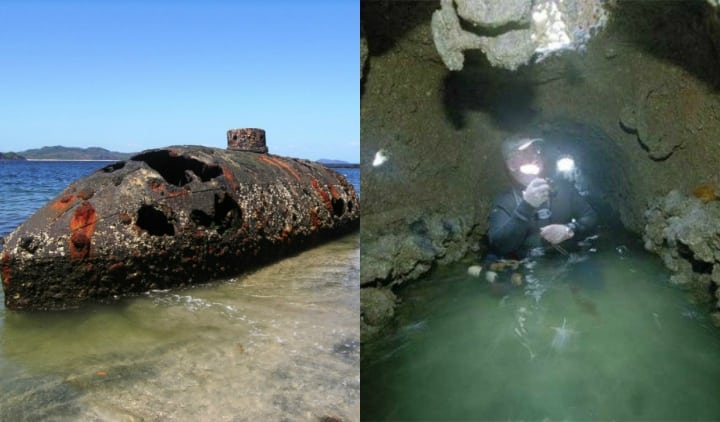
The Sub Marine Explorer suffered a story even more tragic than the others on the list. It was completed by a German inventor by the name of Julius H. Kroehl and an American inventor named Ariel Patterson. It was one of the first underwater crafts and the very first submersible that could go below 100 feet for hours. Six crew members could fit inside the Explorer. It was actually developed for the Brooklyn-based Pacific Pearl Company and not for military use! Unfortunately, the inventors were not aware of the way decompression affected the human body, so it ended in disaster. Crew members suffered “the bends” and died. Kroehl himself was the first of them to die after doing trial runs. They eventually abandoned the vessel because of the condition it induced as well as the overfishing of the pearl beds. Archaeologist James Delgado was the one who discovered it decaying in Panama.
The Sub Marine Explorer
German Submarine U-352
The German Submarine U-352 is also known as a Type VIIC U-boat. It began its military career back in 1942 under the Wolfpack as part of the Kriegsmarine in the Battle of the Atlantic. It later made it to North Carolina where it attempted to down the SS Freden to no avail. It ran out of luck on April 7, 1942, when it fired at a U.S. Coast Guard cutter after confusing it for a merchant ship. The submarine did not have a chance and ended up singing to the depths of the ocean after it was fired at. The spot of the submarine wreck is still a popular scuba diving spot thanks to the artificial reef and colorful fish. The tragedy was survived by Heinz Karl Richter, who told Discovery Channel that Captain Rathke’s obsession with getting a Knight’s Cross of the Iron Cross medal made him want to sink as many ships as possible. Some of the recovered artifacts can be found at the North Carolina Aquarium.

German Submarine U-352
The Guzz
There is an abandoned military graveyard lying just outside Plymouth, England. The site is called the Guzz, and it is quite a spectacle. It is full of formerly cutting-edge marine craft that used to form the nuclear submarine fleet during the Cold War. HMNB Devonport is now home to a dozen submarines like the HMS Courageous, the HMS Victorious, the HMS Vanguard, the HMS Tireless, and the Conqueror. The nuclear engines are actually still intact to this day. Britain needed somewhere to keep the decaying submarines and decided to store it near residential areas, so you can imagine they are not happy about the potential dangers that come with the vessels. The powerful machines were once part of the Navy Cold War Defense system, but they could possibly cause health problems for the residents living nearby.

The Guzz
Hara Submarine Base
For four decades, this site was a bustling military hub for the Soviet Union. Since then, the Hara Submarine Base has been abandoned and vandalized. You will find rusted metal structures and an old lighthouse that have been victimized by external forces and darker times. It was built by the Russian military during the ‘60s and served as a base of operations for the Soviet occupation of Estonia, which lasted until 1991. You would never think that it used to house hundreds of military personnel if you were to look at this place now. The base was made using stones from villages in the area. After suffering at the hands of the Soviets, the Estonians joined hands with their neighbors in 1989 and dismantled the base. It got the attention of the world and forced the Soviets to leave after the collapse of the U.S.S.R.

Hara Submarine Base
The USS Ling
The USS Ling was a high-speed submarine that was commissioned in 1945 under the orders of George Garvie Molumphy. It was created to fight German U-boats in the Second World War, although it did not ever fight in any battle. In 1946, it was taken from the Naval Submarine Base New London to the Panama Canal Zone. The following year, it was decommissioned and then given to the Atlantic Reserve Fleet. The USS Ling was repurposed as a training ship and brought to the Brooklyn Navy Yard in New York, where it was then recategorized as an Auxiliary Submarine. The 2,500-ton submarine can now be found at the New Jersey Naval Museum in Hackensack, New Jersey, although it is not accessible to the public. Despite the interest in restoring it, there was no funding to do this. In 2012, the sub was damaged during Hurricane Sandy.

The USS Ling
The Quester I
What does the Coney Island submarine wreck Quester I and the SS Andrea Doria have in common? The Italian ocean liner, which was called the Titanic of the ‘50s, went down in the Massachusetts coast after it collided with the MS Stockholm. It sank with 46 people and treasures estimated to be worth millions of bucks! After Brooklyn shipyard worker Jerry Bianco heard of this, he built a 45-foot submarine using salvaged metal from the Coney Island shipwrecks to get the sunken treasure. He dubbed it the Quester I and colored the exterior with yellow chromium paint, so it is technically the yellow submarine. Sadly, it got stuck in the banks when the operator did not follow the instructions as he lowered it into the depths in 1970. The vessel has since been abandoned with two dozen ruined vessels in the ship graveyard in Coney Island Creek.

The Quester I
The SFRY Submarine Tunnels
What used to be called Yugoslavia is the site of abandoned and eerie submarine tunnels constructed along the Adriatic Sea. The tunnels in modern-day Croatia made up a strategic military location for the people fighting for the independence of the Island of Vis during the German occupation in the Second World War. The tunnels were the first modern military tunnels built into the Vis hillsides. The island was shrouded in mystery for years since it, particularly the underground tunnel network, used to be the base of the Yugoslavian army when the communism sentiment was still strong. The bunkers were carved deep into the mountains and provided vital military support until they were abandoned during the collapse of Yugoslavia in the ‘90s. It is still a tourist hot spot that thousands of people visit.

The SFRY Submarine Tunnels
The Isle of May Disaster
The Battle of May Island has become known as one of the worst military disasters in history! It was so embarrassing that they did not let the public know about it until the passing of everyone involved. You might have heard of it before, but are you aware that there were no enemy vessels involved? All that was there were a battlecruiser ship as well as three submarines. On January 13, 1918, these British Royal Navy K class submarines collided in the middle of the night after they changed direction all of a sudden while making their way to Scapa Flow, Scotland. They changed directions after they noticed they were about to go toward minesweepers but collided with the other ships in the process. It was disastrous as the two submarines sank, all the crew members on the K4 died, and 51 of 59 members of the K17 crew got killed. The submarines now lie a hundred meters away from each other and 50 meters deep.

The Isle Of May Disaster
XT-Craft Midget Submarines
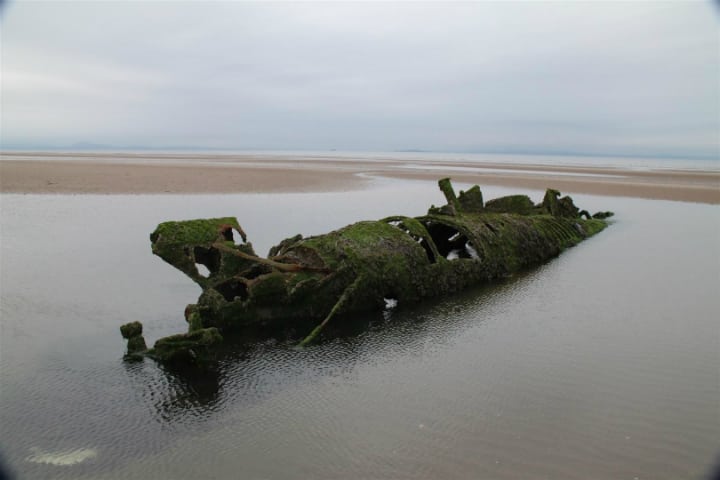
When it is low tide, you will be able to see the two Royal Naval XT class midget submarines hailing from the Second World War. To be accurate, you will see their corroded and wrecked skeletons on the eastern coast of Aberlady Bay, Scotland. They were part of T-Training vessels made by the Vickers’ Armstrong Ltd during the early ‘40s. The subs carried out a highly dangerous and challenging mission against the Tirpitz battleship of the Kriegsmarine in September of 1943. The crews succeeded with their task, which then led the Royal Navy and Air Force to sink the Tirpitz the following year. Two of these subs were brought to Aberlady Bay, where they were moored. The RAF kept using it for tests and practices.

XT-Craft Midget Submarines
Sazan Island
Sazan is a small island off the Albanian coast and once the home of Soviet Whiskey-class submarines. It has since been abandoned, from the obsolete vessels to the networks of tunnels running underneath it. The Soviets operated their biological and chemical weapon plants there, although Albania later seized the base after leaving the Warsaw Pact in 1968. It increased their navy by a significant amount, of course. When the ‘90s rolled in, the subs were already outdated, so they were neglected and then abandoned together with the base. All you will find there now is a barren base against a wonderful landscape. As a surprise to no one, there are plans to convert it into a tourist destination in the future.

Sazan Island
U-475 Black Widow Or Foxtrot B-39
This massive attack submarined used to be a Soviet Navy vessel back in the Cold War. It was used to train Cuban, Indian, and Libyan submariners. Commissioned in 1967, the vessel was categorized under the Soviet Project 641 class subs, although it was known as Foxtrot to the Western forces. When it got decommissioned in 1994, it went to private individuals and then to a public museum ship in England. Four years after that, it was put on display in Folkestone. It now lies waiting for restoration along the River Medway in Strood, England.

U-475 Black Widow Or Foxtrot B-39
Foxtrot Or Zulu V Class B-80
Who would have thought that a navy attack submarine could be repurposed into a party ship or vessel? At any rate, that was the fate of the Soviet Zulu V class B-80 sub, which was a vessel under the Soviet Project 611. This meant that it was part of a series of post-war attack vessels. The submarine was renamed Foxtrot and moved to the Maritime Quarter in Amsterdam North. It is currently in the middle of the harbor since submarine enthusiasts want to take it to the Netherlands. It was initially used as a Museum ship in Den Helder, although it ended up being used as a party venue. The submarine interior was stripped of instruments so that partygoers can do whatever they want inside the craft!

Foxtrot Or Zulu V-Class B-80
Balaklava, Ukraine
The Ukrainian town of Balaklava is so picturesque that you would likely never have guessed that cold, eerie, and long tunnels exist inside the mountain. This was part of the Soviet project to create a secret submarine base with a dry dock and water channel. It used to be called Object 825 GTS and was built in the ‘50s so the submarines could come up without being spotted. The tunnel network came with a nuclear shelter that would protect the nearby town in case of a nuclear attack. There was also a weapon storage facility there. In 1996, it was abandoned and then repurposed into the Cold War Naval Museum.

Balaklava
Object 280
The Soviet Naval Museum complex in Balaklava also came with a massive technical and repair base code called Object 280. This complex was made to maintain and store the nuclear arsenal being transported to the tunnels in the Tavros mountain at the time. Object 280 was basically a special tunnel that they used to load equipment into during the wartime. This made perfect sense since Object 825 GTS was basically created to store, maintain, and repair the vessels from Project 613 and 633.

Object 280
Bigfoot
Have you ever heard of a narco-submarine or a drug sub before? If you haven’t, you should know that the Bigfoot submarine is a kind of an unmanned submersible vessel created by drug traffickers to smuggle drugs and other contraband from a remote location. This was a narco-submarine caught in Ecuador in July of 2010. The members of the Colombian drug cartel have been found to use the submarine to bring cocaine from Colombia to the United States via Mexico. It comes with sophisticated technology, which makes it easier to evade sonar, radar, and infrared detection systems. The subs were dubbed Bigfoot since people used to think that such watercraft was only a myth.

Bigfoot
INS Kursura
The fifth submarine of the Indian Navy was none other than the INS Kursura. During the 31 years it spent in the Indian Navy, the submersible vessel has traveled around the globe and traveled a distance even greater than the Earth’s diameter. The submarine was in service during the Indo-Pakistani War of 1971, participated in naval exercises with various countries, and acted as a messenger of peace. In 2001, it was decommissioned and turned into a public museum on the Visakhapatnam or Vizag. It is considered a “must-visit destination” in the area since it has not lost its originality no matter how much time has passed by. It was nearly flooded when Cyclone Hudhud hit in 2014, but the government did something about it.

INS Kursura
Horse Sand Fort
This is one more British submarine base and fort that the Royal Commission used in the past. Horse Sand Fort is a sea fort located in the strait of Solent in Portsmouth, England. Originally intended to be a part of the Palmerston Forts, it was used by the British during the Second World War as it was heavily equipped with sophisticated weapons and submarine defenses. The iron-armor gates and walls and layers of concrete and granite were great. It was purchased by AmaZing Venues with the intention of turning it into a museum.

Horse Sand Fort
Puget Sound Naval Shipyard
Puget Sound Naval Shipyard and Intermediate Maintenance Facility is a U.S. Navy shipyard located in the state of Washington. It has been in operation since 1891 under a ship-submarine recycling program. At the moment, it holds four decommissioned aircraft carriers, a submarine tender, and 16 nuclear submarines waiting to be scrapped. The shipyard comes with a reserve fleet should the Navy ever need them. Sometimes called the PSNS, this is the only shipyard facility in the country that is certified to recycle nuclear ships. Since 1990, it has scrapped a number of cruisers and more than 125 submarines.

Puget Sound Naval Shipyard
Johnston Atoll
The Johnston Atoll is operated by the U.S. Fish and Wildlife Service, although it was initially the playground of the military for seventy years. Located in the Pacific Ocean, it was among the most isolated bases in the world. Initially a bird refuge, it was converted to a military service location during the ‘30s. It was meant to repair, refuel, and maintain aircraft and submarines. Back in its heyday, there were 1,300 personnel living and working on the station before it became a nuclear testing facility during the ‘40s. As some of you might know, Johnston Atoll is infamous for storing and disposing of the chemical weapon called Agent Orange. The radioactive and nuclear testing meant led to the leaking of petroleum and chemical products into the surrounding areas in the ‘60s. Efforts to clean this up is still ongoing.

Johnston Atoll
Soviet Submarine K-77
The Soviet K-77, also known as the Juliett-class submarines, was a part of Project 651. It was a cruise missile submarine commissioned in 1965 under the Northern Fleet of the Russian Navy. The Juliett-class subs were withdrawn in 1988, although this did not mean the K-77 had to go under. In 2002, it was featured in K-19: The Widowmaker with big stars like Harrison Ford and Liam Neeson. After the movie, it was then brought over to Rhode Island to be converted into a museum under the management of the USS Saratoga Museum Foundation. Unfortunately, it sank thanks to a storm on April 18, 2007. They were able to recover it the following year, although it had deteriorated so much it had to be scrapped instead.

Soviet Submarine K-77
Type-A Midget Submarine
The Japanese Type-A Midget Submarine dates back from the Second World War. The killer whale-shaped vessel lies deserted on Kiska Island out on the Aleutian Islands in Alaska. When the Japanese withdrew from there in July 1943, they decided to destroy their subs using internal explosive charges. That is why all that remained of the vessel was the skeleton, although it can be thought of as an unprotected artifact that people can squeeze themselves in. During the Second World War, Japanese troops built military infrastructure and defense measures on the island to get to U.S. territories.

Type-A Midget Submarine
Object 221 or Bunker Alsou
Object 221, also known as Bunker Alsou and Protected Command Point Black Sea Fleet, was a Soviet stronghold in the Mishen Mountains, Ukraine. The bunker is the biggest underground structure in the country with the exception of the subway. The Soviets used the stronghold to keep the Black Sea command safe from a nuclear attack by the U.S. Built in 1977, the tunnels run for over 6 miles with four levels that go into the mountain. The bunker was clearly a Cold War product like Object 825, the Balaklava nuclear submarine base since it was the regional headquarters for the Black Sea Fleet. It was also the emergency command center for the Soviet military.

Bunker Alsou
Liepāja
Liepāja is an ice-free harbor in Latvia on the Baltic Sea. It ensures the cargo exchange between West and East Europe with its 16 terminals. The port is the third biggest port in the country, although it used to serve a different purpose. The harbor at Liepāja used to house 16 submarines and a nuclear deposit in the neighborhood of Karosta. It was built as a naval base for Tsar Alexander III and was repurposed into the Soviet Baltic Fleet base. The abandoned place is popular among artists and tourists who want to witness the lovely seascapes on the shore of the Baltic.

Liepāja
Saint Nazaire Submarine Base
During the Second World War, the Nazis built several huge submarine bases in France. Saint Nazaire was part of this list. As a matter of fact, the base was one of the five biggest submarine bases built by the Third Reach in Vichy France. After the arrival of the Germans in June 1940, they overtook the harbor and used it for submarine operations. The allies destroyed Saint Nazaire but left the base intact. It was eventually turned into a cultural site with museums, a French submarine, and bars. It is worth a look!

Saint Nazaire Submarine Base
Submarines of Alexandrovsk-Sakhalinsky
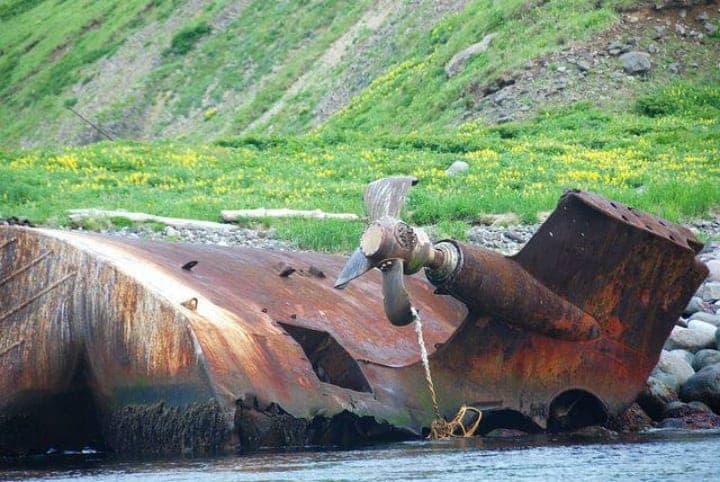
Along the shores of Alexandrovsk-Sakhalinsky in Russia, you will find a couple of rusted submarines half-submerged. Alexandrovsk-Sakhalinsky is a town located in the Sakhalin Oblast next to the Tatar Strait beside the Western Sakhalin Mountains. When it was occupied by the Japanese forces from 1918 to 1925, it was called Akō. This area was used as a military post in 1881 as well, which is why there are corroded submarines lying abandoned in the water. No one is positive why they are there, although the vessels certainly add more character to the region.

Submarines of Alexandrovsk-Sakhalinsky
Maunsell Sea Forts
The Maunsell Sea Forts are towers created during the Second World War in the Thames and Mersey. Built to defend the United Kingdom, the towers worked as army and navy fronts to survive the impact from the Nazi air raids and submarines. The base was decommissioned in the late ‘50s, although it was later used for the pirate radio broadcast in the ‘60s.

Maunsell Sea Forts
Olenya Bay
When you go to the Russian Naval base in Olenya Bay, you will see a submarine graveyard on its shores. Located on the Kola Peninsula, the base is a bleak naval facility that is home to Cold War vessels and hardware. The rusted submarine below dates back to the ‘70s. The reason the submarine was abandoned there was that the shipyard could no longer deal handle all the massive military vessels. A lot of the submarines were then towed away and left for dead near the Nezametnaya Cove.

Olenya Bay
Pacific Fleet Submarines Nuclear Shelter
This unfinished nuclear shelter was meant to hold the Pacific Ocean Fleet Soviet subs. Located in Pavlosk, it is a dark labyrinth of tunnels that seem to be frozen in time. The base served as a Soviet hideout for submarines, although it was deserted 30 years before it could even be used. The construction started in 1960 and started out with two massive parallel tunnels that then connected to smaller tunnels. Unfortunately, construction started slowing down in the ‘80s until it was ultimately abandoned. There is a good chance it could still be used in the future upon its completion, however.

Pacific Fleet Submarines Nuclear Shelter
Olavsvern
Outside the Norwegian city of Tromsø is this decommissioned base of the Royal Norwegian Navy. It is a large complex hiding in a mountain. It comes with a submarine hanger made with rock as well as direct access to the sea. The government reached the decision to close it in 2008 after the navy was restructured. Moreover, they actually put it on the market in 2011. They eventually gave it to an oil rig firm for the price of $4.3 million or 38 million kroner. However, reports say there is Russian military activity happening down there.

Olavsvern
The Maginot Line, France
The French Government built a series of fortifications in the 1930s – The Maginot Line. It ran along the border with Germany and its main purpose was to stall a possible German invasion. It meant to allow the French mobilize their own armies while holding back enemy forces. While it was a good idea, in theory, it wasn’t too effective when push came to shove. The Germans invaded from a direction the French hadn’t anticipated and conquered France in six weeks in 1941. Not to mention that the Maginot Line was too expensive to maintain, let alone during a war. To this day, the Maginot Line still exists, but it isn’t maintained or in use anymore.

The Maginot Line
Puget Sound Naval Shipyard
Established in 1891, this Naval Station was designated Navy Yard Puget Sound in 1901. During WWI, the Navy Yard built ships as well as roughly 1,700 small boats. In WWII, the shipyard’s main effort was to repair the battle damage caused to the U.S. fleet and its allies. Once WWII was over, Navy Yard Puget Sound was designated Puget Sound Naval Shipyard. It worked on modernizing carriers. During the Korean War, the shipyard was engaged in the activation of ships. By the late 1950s, it began new construction with the building of a new class of guided missile frigates. By 1992, the shipyard was designated a National Historic Landmark.

Puget Sound Naval Shipyard
UC-61
Over 100 years ago, a German crew on a submarine during WWI mistakenly ran aground in France. As a result, the 26 Germans surrendered and abandoned the submarine, which sank by the 1930s. However, recently, shifting sands are slowly revealing the submarine, officially known as UC-61. According to the BBC, it’s now turning into a tourist attraction. Since December 2018, two sections of the submarine have been visible at low tide on a beach in Wissant, a city near Calais.

UC 61
RBU-6000
The RBU-6000 is a 213 mm caliber Soviet anti-submarine rocket launcher. The system began service in 1960-61 and it made for a wide range of Russian surface vessels. The horseshoe-shaped arrangement is remotely directed by the Burya fire control system. This anti-submarine rocket launcher was the most widespread one in the Soviet Navy and was used on many ship classes.

RBU 6000
RAF Hethel, England
A former Royal Air Force station, the RAF was used by both the Royal Air Force and the United States Army Air Forces (USAAF). During WWII it was used the most. It’s located near Norwich, Norfolk, England. Nowadays, it’s owned by Lotus Cars. In 1966, the car company built a factory on the site of the airfield and from then, they’ve built factory and engineering centers and reused 2.5 miles of former runways for test tracking their cars.

RAF Hethel England
USS Thresher (SSN-593)
The second USS Thresher was the lead boat of her class of nuclear-powered attack submarines in the United States Navy. However, disaster struck on April 10, 1963. Thresher sank during deep-diving tests about 220 miles east of Boston, Massachusetts. As a result, all 129 crew members were killed in the deadliest disaster ever. Following this loss, the U.S. Navy implemented a rigorous submarine safety program named SUBSAFE.

USS Thresher SSN 593
USS Scorpion (SSN-589)
The USS Scorpion was a Skipjack-class nuclear-powered submarine that served in the U.S. Navy and the sixth vessel of the Navy to carry that name. On May 22, 1968, Scorpion was lost, with 99 crew members dying as a result. This submarine is the second nuclear submarine the U.S. Navy has lost. This was only one of four mysterious submarine disappearances in 1968, with the others being the Israeli submarine INS Dakar, the French submarine Minerve and the Soviet submarine K-129.

USS Scorpion SSN 589
Komsomolets
In the 1980s, the Soviet Union built a super submarine that was nothing like anyone has ever seen before. Fast and capable of incredible depths for a combative submersible, the submarine Komsomolets was introduced in 1984. Just five years later, Komsomolets and its nuclear weapons were at the bottom of the ocean, two-thirds of its crew killed in what was considered yet another example of Soviet incompetence. The submarine sank in 5,250 feet of water, complete with its nuclear reactor and two nuclear-armed Shkval torpedoes. From 1989 to 1998, seven expeditions were carried out to secure the reactor against radioactive release and seal the torpedo tubes. Russian sources claim that during these visits, evidence of “unauthorized visits to the sunken submarine by foreign agents” were discovered.

Komsomolets
Pavlovsk Bay
This secret underground base was discovered by explorers. It is now disused, but it was originally dug to store many of the Soviet Union submarines. The base is believed to be able to withstand a nuclear attack, but it seems like it was abandoned before it was ever fully used due to the Cold War ending. The explorers who found it managed to gain access to the series of tunnels thanks to the frozen water brought about due to the Siberian weather.

Pavlovsk Bay
Camp X-Ray
In the thickets of the US Naval Station in Guantanamo Bay, Cuba, is the former military base known as Camp X-Ray. You can see from the image that a solid amount of infrastructure remained intact, along with the agriculture. In this image is a detention facility that was abandoned, and it seems like people don’t hang around the area too often. Honestly, we can’t blame them.

Camp X-Ray
Balta
Try not to let the painted eye distract you. It’s clearly a work of art that was added many years after WWII took place. During the war, the US military set up camp here. This crumbled building was part of a base located in Balta, a small area in the Galapagos Islands. It’s truly haunting to think about how much has changed here since then.

Balta
Brdy
This huge indoor space is a place the US military actually considered setting up camp in the late 2000s. Previously, it had been a Soviet base, located in Brdy in the Czech Republic. It isn’t clear why the Americans never went through with it, but if they had, they would have used this military base as a place to set up an anti-missile radar system. As you can see, it’s still abandoned to this day.

Brdy
Greenham Common
Nowadays, this station is out of use. However, in the late 1980s, Greenham Common Royal Air Force station in Berkshire, England, was very different when 35,000 people gathered to protest the use of nuclear weapons. Whoever knows the history of this place must feel some disparity between this picture compared to how it once looked. In 1990, the station was closed, so now all that can be heard in this abandoned spot is silence.

Greenham Common
Fort Ord
We can’t tell if this is an abandoned military base or a skate park. In all seriousness, all the graffiti you see here really goes to show just how much time has passed since the US military was using this base. Fort Ord is located in Monterey County, California and was built in WWI. During WWII, it was able to hold up to 50,000 soldiers. In the 90s it got tagged for closure, but other than this swimming pool, California State University used some of the areas for their campus.

Fort Ord
FOB
Forward Operating Base (FOB) is located in Afghanistan and was abandoned by the US military back in 2014. However, they left a parting message. As you can see, their instructions are simple: “Do not tear down”. We don’t know if this means they will return, but it seems that these structures must be important. Otherwise, the Americans wouldn’t leave such a message, would they? In any case, this whole area looks eerie.

FOB
Camp Dunlap
During WWII, the US Marine Corps set up a base in the California Imperial Valley desert which stretched across 630 acres. They named it Camp Dunlap. In the 1950s, it was closed for good. Eventually, people began flocking to the area to set up “homes”. Trailers, RVs, you name it – they set up camp on multiple concrete slabs which is why the area ended up with a brand new name: “Slab City”.

Camp Dunlap
Wünsdorf
Another swimming pool that was part of a military base, this one has been completely drained and abandoned along with the rest of the place. This military camp was called Wünsdorf. It’s said to be the largest Soviet military base outside of Russia, which says a lot. While this photo looks pretty bleak, the pool must have been pretty magnificent back in its heyday.

Wünsdorf
Željava Air Base, Croatia
On the border between Croatia and Bosnia and Herzegovina, there was the largest underground military airbase airport in the former Yugoslavia. Construction of the airbase began in 1948 and was finally done in 1968. Throughout those two decades, SFRJ spent about $6 million on the construction. In 1991, the airbase was used intensively during the Yugoslav Wars. During the withdrawal, the army destroyed the runway by filling pre-built spaces with explosives and detonating them. To ensure no one would use the place again, the Military of Serbian Krajina completed the destruction in 1992. The explosion was so powerful that it shook the nearby city and its smoke continued to rise for six months after it.

Željava Air Base Croatia
Duga 3: Ukraine
Operating from July 1976 to December 1989, the Duga 3 was a Soviet over-the-horizon radar system which was used as part of the Soviet ABM early-warning network. Two radars were deployed, later being deactivated in the late 1980s. They lie around the Chernobyl power plant.

Duga 3 Ukraine
Her Majesty’s Naval Base Devonport
Her Majesty’s Naval Base Devonport is home to more than a dozen submarines. Essentially, it’s a time-capsule of decommissioned submarines. Some of these subs were in their heyday during the Cold War when they were part of the U.K.’s Continuous at Sea Deterrent. In the 1990s, one submarine, the HMS, became one of the first to carry the Trident Missile System. You can actually visit the maritime museum at Her Majesty’s Naval Base Devonport, but careful – some of the submarines still have their radioactive cargo intact.

Her Majestys Naval Base Devonport
Flak Towers, Austria and Germany
The Flak Towers were composed of eight complexes of large, above-ground, anti-aircraft towers that were constructed by Nazi Germany in the cities of Berlin, Hamburg, and Vienna (Germany and Austria) in 1940. These towers were used by the Germans during WWII to defend against air raids.

Flak Towers, Austria And Germany
Palmerston Forts
Many island forts off the coast of Britain were built during Victorian times to offer some type of resistance to the French invasion. Later, these forts were useful in serving as defense stations during World War I. During this time, some thought they could serve as a line of protection against submarine threats. After this, some forts were kept open, but these closed due to disease on the island.

Palmerston Forts
Ghost Fleet, Suisun Bay
In Suisun Bay, which is off the coast of San Fransisco, California, an abandoned fleet of U.S. Marine war ships once floated together on the water. This Ghost Fleet used to be a strong 50 abandoned ships, until the environmental hazards of decaying ships and chipping paint led the removal of most of the ships to museums and junkyards.

Ghost Fleet, Suisun Bay
Charleston Navy Shipyard
The Charleston Naval Shipyard, which orignally opened its doors in 1901, contributed to multiple U.S. wars. One key role this shipyard played was in World War II; it served as as a home for naval ship repair and construction. The site closed in 1995, and since then, parts of the property have undergone redevelopment though portions of the historic site which remains intact.

Charleston Navy Shipyard
Fort Terry, New York
This site, which was built on Plum Island off the coast of New York in 1898, was used as defense during the Spanish-American War. The site was also heavily used during both World War I and II. Once this site was deemed unnecessary for protection in 1969, the fort was transformed into the Plum Island Animal Disease Center.

Fort Terry, New York
Swiss Military Bunkers
Even in what is deemed to be a neutral country, Switzerland was ready for plenty in the way of military attacks back in the day. They created a huge network of secret bunkers located within rocks, barns, or hillsides. Most have been long abandoned, but even still, the Swiss military bunkers, located in the Alps in Switzerland, are the exact definition of camouflage. Wow.

Swiss Military Bunkers
Cambridge Military Hospital
The Cambridge Military Hospital was the first military base hospital. It opened its doors in July, 1879 in Hampshire, England. The hospital welcomed soldiers directly from the Western front during war. The hospital served multiple functions for a century, including being the first hospital to perform plastic surgery, and eventually closed down in the 1990s due to the high costs of operating an aging building. Some recent reports have developers hoping to turn parts of the empty building into housing.

Cambridge Military Hospital
The Russian Woodpecker
Though it is more common for military bases to be built underground, one giant antenna nicknamed the “Russian Woodpecker”, was built up 50 stories high and is positioned in the wilderness of Russia. Before the military site became abandoned, it was a part of the Soviet’s powerful radar system which was used during the Cold War. Though it is not an active military unit anymore, it still remains a landmark for tourists.

The Russian Woodpecker
Cape May Bunker, New Jersey
The Cape May Bunker, which was built on the sand off the coast of Cape May in New Jersey, served as a gun placement to protect America’s East Coast. It was originally constructed at the beginning of World War II when U.S. military leaders thought that war could cross into American shores, but the site is no longer active. The bunker is now part of a New Jersey state park.

Cape May Bunker, New Jersey
Greenbrier Bunker
The Greenbrier is a golf resort located in West Virginia. Tucked 720 feet into the hillside below that resort is the Greenbrier Bunker, which used to be a secret location built to keep Congress members safe in the event of a nuclear war. Construction of the bunker was completed in 1961 and was maintained by government employees working undercover. The bunker came heavily equipped with its own power plant and water-purification unit, a 25-ton blast door, a cafeteria, a medical clinic, decontamination chambers, meeting rooms, and more. The facility was kept top secret until The Washington Post exposed it in 1992, forcing the government to decommission it. Now the site is open to the public for tours. The resort that surrounds it still remains in business.

Greenbrier Bunker
Fort Jefferson
An island fortress, called Fort Jefferson, was constructed in the Florida Keys in 1846 to help fight against piracy in the Caribbean Sea. A tall, six-sided brick wall encompassed a set of living quarters where soldiers and equipment were stored. After the tension settled, Fort Jefferson turned into a Civil War prison. Today it serves as a national monument commonly visited by tourists.

Fort Jefferson
Inuvik Dome
Throughout the Cold War, the whole world watched nervously. Even the Artic was involved in the war; it created a system called Distant Early Warning (DEW), meant to detect incoming bombs launched toward North America. After the Cold War, the governments of the United States, Canada, Greenland, and Iceland quit their operations and the dome-shaped structures were all either abandoned or dismantled.

Inuvik Dome
Wolf’s Layer
Hitler resided in several bunkers during World War II, but none more famous today than “Wolf’s Lair” in Poland. This steel-reinforced concrete building was Hitler’s home and hiding place for over two years during the war. This home was where he made the decision to construct the death camps. He managed to survive an assassination attempt in the bunker, and following the Germany defeat, much of the bunker was destroyed. Small parts of the bunker remain intact, though now deserted and coated in thick moss. Still, the hideout is a popular tourist attraction.

Wolf’s Layer